Always new, always intoxicating

Voloshyn Gallery is pleased to annaunce Kateryna Oliinyk's solo exhibition — Always new, always intoxicating,
Kateryna Aliinyk, artist
Text by Milena Khomchenko, curator.
It seems, when wars begin, nature loses its freedom — one that belongs to it by the very foundation of its own being. The dialogue between humanity and nature becomes uneven. Its beauty is reduced to a resource, its autonomy erased by people’s presence. It seems, when evil finally recedes, beauty flows into a state in which one no longer seeks to overpower it, to “gain control of the wind”. But does horror truly destroy beauty? It acts as a lens, sharpening our gaze upon all that is human, imprisoning us in a state of tension, turning beauty into a mere mist for which there is no place in a rationalized contemporaneity. Yet beauty does not disappear. While humanity destroys steel and concrete, the beauty of a moonlit night remains untouchable by guns and missiles.
Kateryna Aliinyk's solo exhibition charts a shift in the artist's perspective. Her prolonged engagement with the themes and images of war, like a bottomless well in which grief and horror never run dry, had led to an equalization of the artist's identity with home, and of home, in turn, with war. Paradoxically, evil becomes easier to work with, while reaching out toward joy and beauty demands deliberate courage. It is always frightening to die, but to live with honesty and to honour beauty amid grief is perhaps a more desperate act. The exhibition emerges from an intimate conversation between the artist and the curator, both experiencing a period of re-encountering the world — one in which prolonged absence transforms home into a fantasy they had continued to cultivate and romanticise, drifting further from reality with each passing moment. Surprisingly, a new encounter with the Lacanian Real presents itself not as an emptiness, but as a beauty that intoxicates. Not merely the kind that is brief and instantly elevating, but the kind that exists beyond the bounds of misfortune and fortune alike.
Without any wish to place oneself within it or to touch it, beauty envelops. It is that life-giving fluid which flows through the veins of every human action. The dialogue between the curator and the artist reaches back into the centuries, opening into a polylogue with writers who matter to them: from the medieval thinker Hildegard of Bingen to Simone Weil, the philosopher and activist of the 20th century. "To see a landscape such as it is when I am not there," Weil wrote in her notebooks, wishing not to disturb the silence of earth and sky with her breath or the beating of her heart. As the artist’s interlocutor, I felt that distance, that harmonious non-presence, when the artist accompanied me through the world of celestial bodies. She would stop before some branches obscuring the moonlight and did not try to clear them away, simply staying there for long minutes of measured contemplation. So too, in the triptych Moon in Hair, on the left side, branches of trees or strands of hair encircle the satellite. Juxtaposing scales and heights, Aliinyk captures the living matter and clusters of organisms in paint. In Resting in the Lowlands — birds descend to the earth, while in Resting at the Altitude spiders drift beneath the heavens.
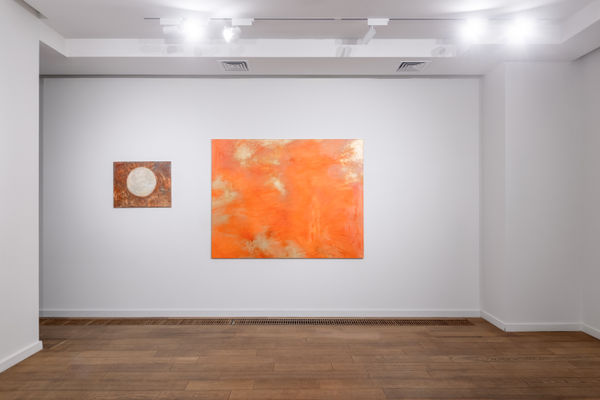
The exhibition includes a series of new works created in late 2025 and early 2026. Shown in an exhibition space for the first time, the series comprises canvases depicting the sky and a single work with an earth scene. As the artist's thematic perspective shifts, so too do her images and forms. Earlier, her static landscapes were dense with detailed elements and humanised by objects of action, such as a stage or a fence, remnants of food or bullet casings. Now her gaze is fixed to a place to which not only is she distant, but in which she cannot be physically present. Celestial bodies, or the sky itself as an integral dense mass, convey movement in contrast to a landscape frozen in a moment; a strong blue wind ripples the canvases, the orange hued air is heavy with metal.
Aliinyk's beauty, like Weil’s, is Kantian — an end in itself. It grows dense, materialises, yet always remains transcendent, dissolving, slipping further and further from our glance each time. And yet every day and minute, we encounter an always intoxicating sky, always a new beauty.